Saturday, September 26, 2015

As SLow aS Possible : the pitch drop of music

Listen to this first.

This is not pleasing to hear. By any stretch of the imagination. Melodic is not a word I’d associate with this rendition in any state of mind. A commentator on youtube likens this with nails on a chalkboard. I am tempted to agree.

That should not be the case, however. The composer is the celebrated John Cage1, a twentieth century US composer whose most famous composition, titled 4’33”, is essentially musicians sitting around for four minutes and thirty three seconds doing absolutely nothing. The point of the composition is not to enhance silence, but to focus on the surrounding background noise the audience hears during the performance. I am not qualified at all to critique the piece; numerous capable people have already done so, and a quick glance through the composition’s Wikipedia piece should be enough to satisfy the casual reader. If you want to glance through more of John Cage's work, the folks over at Artsy have a rather nice page on him.

This post is not about 4’33”. It is about another of Cage’s startling creations, a composition titled Organ²/ASLSP (As SLow aS Possible), written for the organ. Given that the organ has infinite sustain–you can hold one note for as long as necessary–this piece can, technically, be played forever. Cage never listed a specific way of playing it, and multiple performers have played it for various lengths of time. In 2009, Diane Luchese, a professor in the department of music at Towson University, performed the piece uninterrupted for fifteen hours. However, this was nowhere close to the longest performance of this piece.

In 1361, one of the very first permanent organs was installed in the Halberstadt Cathedral in Germany, six hundred and thirty nine years before the turn of the millenium. In 1997, musicologists decided on a performance that would play Cage’s piece Organ²/ASLSP for 639 years beginning in 2000. The performance began on Sept 5–this was Cage’s birthday–in the year 2001 in the St. Buchardi church at Halberstadt and is scheduled to conclude in 2640. The opening note was a rest, and there was silence for almost a year and a half, with the first sound being heard only in February of 2003. So far, thirteen notes have been played, and the next change is scheduled for 2020.

Such long artistic performances are possibly a recent phenomenon. Scientific parallels would include the Pitch Drop Experiment2, where tar forms a single drop over several years.

The University of Queensland
pitch drop experiment.
The video at the beginning of this post turns this on its head by showing a performance of As SLow aS Possible in 37 seconds, almost 545 million times faster than the project underway in Halberstadt. It manages to prove that the piece should probably not be played fast.


  1. Nothing whatsoever to do with the Mortal Kombat character.
  2. This allows for nice wordplay with the concept of pitch in music.

Wednesday, September 23, 2015

How much water is actually there on the Earth?

Picture this.

From http://funsubstance.com/uploads/gif/169/169538.gif

A recent post that has gone viral claims that this is what the Earth looks like "without water". That is, if some alien water-reallocation company--call them Spacetlé, just for laughs--were to zoom over to our fair planet tomorrow and suck out all the water from our oceans and leave us, literally, high and dry, this is what we would be standing on. Rather lumpy, ain't it, a dry Earth?

'cept it ain't correct. This is definitely not what the Earth looks like if Spacetlé were to suck it dry tomorrow. This is what the Earth looks like if it was redrawn so that, at every point on its surface, the net local gravitational field were to point perpendicular to the ground at the point. In other words, this is the Earth's geoid. Now, you might say, waittaminit! I know that at Earth's gravity is trying to pull me towards its centre everywhere on Earth. Right? Right?

Well, not quite. You see, that would be exactly correct if the Earth were a homogeneous uniform mass sphere. The gravitational field would indeed point radially inwards at each point on the surface, and you would indeed be pulled towards the very centre of the Earth. However, the Earth is not completely spherical. And it isn't completely homogeneous. You see, Earth's gravity comes from its mass {d-uh}, and depends on how that mass is distributed across its volume {hu-d; that is like, a retort to d-uh...saying it backwards, y'know}. Since the mass of the Earth isn't uniformly distributed, with some parts being denser than others, the gravitational field of the planet is also not uniform, and tends to point away from the centre at most places. Of course, the deviation is probably too small on the scale of the Earth to really matter too much.

So what is the cute colourful potato doing at the top of this post, merrily spinning away? If it isn't the Earth sans its water, what is it? I think I'll let Bad Astronomer Phil Plait explain that bit.

You might ask, what am I doing basically repeating the same thing that Plait has said so much more clearly in his post? Why does the world need another near-clone blog post on the same topic? Well, that is because I want to talk about something else. As I was reading Plait's post, a second figure caught my eye...and my attention. It is a picture of the Earth without its water. For real, this time, that is if Spacetlé had really succeeded.

From http://water.usgs.gov/edu/pictures/global-water-volume-fresh.jpg
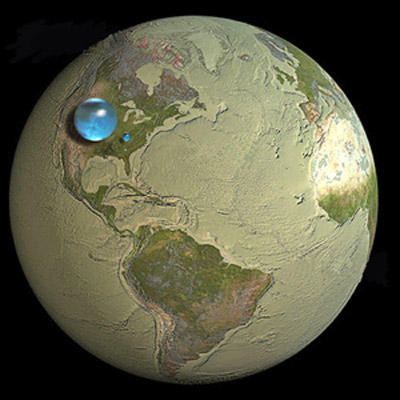
The large drop is all the water the Earth has
The graphic is originally from this article. The large drop of water is all the water that Earth has. All of it. The smaller one is the total fresh water we have, whereas the smallest, almost invisible, one is the water in lakes and rivers.

Not a lot, is it?

Well, no, not if you compare it to the Earth. But do keep in mind that the diameter of the big drop is almost 1400 km. Which means there is total of almost 1.4 * 10^18 cubic meter, or about 1.4 * 10^21 litres of water on Earth. That is indeed a lot from a human scale. However, most of this water is not drinkable. The smaller sphere can be drunk, but most of it can't be obtained easily by humans. What we can drink is the smallest sphere, which has a diameter of a mere 56 km. Which translates to 733 million billion litres of water (7.33 * 10^14 cu-m). Given that, say, an average person drinks about four litres of water per day, and there are 7 billion people on the planet, about 28 billion litres of water is drunk per day. That is about 10000 billion litres per year. At this rate, we would have drunk all the water the Earth has right now in about 73 thousand years. Of course, it doesn't quite work that way. But hey, fun exercise. If I did it right. Which I sincerely doubt.

Sunday, September 13, 2015

Markandey Katju, Subhash Bose, and Bengalis

India's outspoken judge, Shri Markandey Katju, took to Facebook yesterday in an outburst against Subhash Chandra Bose. I quote his entire article here, syntactical and grammatical style unchanged, except for the bit in bold near the beginning, which I was responsible for.

The Japanese agent Subhas Chandra Bose 
I hold Bengalis in high respect. They are a highly intelligent, highly cultured people, with great contributions in literature, science, philosophy,social reforms, etc
Unfortunately, many of them have some blind spots. It is diifficult to talk rationally with many Bengalis about some personalities whom they have converted into icons or holy cows, e.g. Tagore or Subhas Chandra Bose. Even the slightest criticism of these persons invokes a torrent or barrage of invectives and vituperations.
I remember when I was a Judge of Allahabad High Court I was sitting with some other Judges, one of whom was a Bengali, at the house of one of my colleagues. I mentioned my view that Subhas Chandra Bose was a Japanese agent. This so infuriated the Bengali Judge that he started shouting and raving almost like a madman, and so I quickly apologized so as not to break up the party.
But why should Bengalis go crazy if someone rationally criticizes Tagore and Bose ? Are they the private property of Bengalis.?
I have already mentioned my view about Tagore on my blog justicekatju.blogspot.in in which I have said that Tagore was objectively a British stooge, who had been built up by the British ( through their agent Yeats ) so as to divert literature from the revolutionary direction Sharad Chandra Chattopadhyaya was taking it ( see his Pather Dabi ) towards harmless and nonsensical spiritualism and mysticism ( see Gitanjali, Agni Beena Bajao Tumi, etc ) so as not to harm British interests.
I had also called Bose objectively a Japanese agent, in one of my blogs.
Today I read in the newspapers that Mamata Banerjee has decided to throw open the state government's files on ' Netaji '.
In my opinion this is just a diversionary populist measure to divert attention from the real problems of Bengalis ( and other Indians ) of poverty, unemployment, healthcare, price rise, malnourishment, etc.
Moreover, it is high time for Bengalis ( and other Indians ) to make a rational assessment of this ' national icon ' ( as Mamata described him ).
In Germany, Bose not only hobnobbed with Hitler but even with Himmler, two of the most evil men in history, ( their photographs can be seen on the internet ) responsible for sending millions to gas chambers. He wanted to organize the Indian soldiers captured by the Germans, to fight along with the Nazis. But when Hitler showed no interest, Bose went to Japan and raised his ragtag 'Azad Hind Fauj ' to fight with Japanese support against the British army.
In my opinion Bose was a highly ambitious person, and he became a Japanese agent because neither Gandhi nor Hitler had given him any ' bhaav ', so he thought that the only alternative left was to ally with Japan.
The Japanese fascists used Bose in their fight against the British, but the moment his utility was over they would probably have bumped him off.
Does anybody think that the Japanese fascist imperialists would have given freedom to India if they had defeated the British ? No, they would have made India their colony ( as they made Korea, Manchuria and other parts of China, Vietnam,etc ) and looted us. If we resisted, the Japanese would assuredly have massacred our people, as they did to the people of Shanghai, Nanking, etc ( see on Youtube visual accounts of these massacres ).
If Bose was a great freedom fighter, why did he give up the fight against the British the moment the Japanese surrendered ? He should have carried on a guerilla war against the British, the way the Chinese Eighth Route Army fought against the Japanese. In guerilla war you fight with the weapons of the enemy, by snatching them from him. The fact that he did not do so shows that there was nothing in the man. First he tried to become an agent of the Nazis, but they rebuffed him. Then he became an agent of the Japanese, who accepted him as their loyal running dog.
Some people support Bose's alliance with the Japanese by saying that an enemy's enemy is one's friend. In the real, practical, world, this maxim cannot be of universal application. Moreover, one can understand alliance with Japan if there was a possibility that such an alliance could have given us real freedom. But there was no such possibilty. Even if the Japanese, with I.N.A. support had defeated the British, they would never have given us freedom, but converted India into their colony. The very nature of the then fascism prevailing in Japan makes this evident.
My assessment of Bose is that he was an over ambitious, confused person, who to satisfy his ambition and ego was prepared even to ally with the devil, like a Faust. It is high time Bengalis ( and others ) realize this

So he obviously doesn't like Bose or perhaps even Gandhi and company. Which is fine. He is entitle to his opinion, as is everybody else in what is still probably a country that allows free speech. Which of course resulted in a volley of abuse and criticism in the comments section. Katju's standard reply, and one that I quite agree with, is "abuse does not equate with argument". Here are two such examples.


He seems to be driving that point home. Nothing wrong in that. Constructive criticism goes a lot further than abuse. So imagine my surprise when this happens.


Now that was plain uncalled for. I understand he might have had a beef with Bengalis in the past, but this is simply violating the very principle that he himself expounded. Besides, he began his post declaring that he "holds Bengalis in high respect". This sort of turnaround brings into his entire line of argument into question; if you contradict yourself within a period of two minutes (as can be seen in the time tags), how can anyone take you seriously sir?

Turning back time : Spin round the earth really really fast

The recent revival of the live action superhero movies has made comic book fans rather happy. The Marvel Cinematic Universe, or the MCU (not the Major Crimes Unit of Gotham City, that is DC comics), started in 2008 with Iron Man, a movie that jump-started Phase I of the MCU as well as revived Robert Downey Junior's career. With one excellent movie after another--interspersed with the pedestrian Thor movies or the somewhat underwhelming sequel to the Avengers--the MCU has swiftly taken its place among James Bond and Harry Potter as one of the most lucrative and popular movie franchises of all time. DC comics has also attempted to duplicate Marvel's success, but with questionable success, with a disastrous Green Lantern movie and a rather soulless Man of Steel.

Which brings me to Superman live action movies. I'll begin with the most recent one, which gets a bit of a Nolanesque Dark Knight treatment, being all dark and gritty and joyless. Not surprising, considering that Nolan was in the production team. The problem with making a Superman movie humourless and dark is that it does not work as well. Dark and gritty are the Batman's territory, while it is up to his foil Superman's job to keep things happy and shiny.

Which is of course what the excellent 1978 Richard Donner movie managed to do flawlessly. With Christopher Reeves as an almost perfect Superman/Clark Kent, Donner never quite let go of the fun, comic-booky feel of the plot, blending real danger--such as the flooding due to the breaking of the dam--with its rather silly reason hatched up by an equally silly Lex Luthor played by Gene Hackman. Thanks to Superman's timely intervention, the total number of casualties of Luthor's nutty plan is precisely one.

And that is when the penny drops, for that one person who manages to get herself killed is Lois Lane, Superman's love interest, played brilliantly by Margot Kidder (honestly, she is by far the best live action Lois Lane; Dana Delany of course is equally good as Lane's voice in the Superman animated series as well as in Justice League). When Lane dies and Superman fails to revive her, Reeves does a passable and much more humane impression of Shatner's Khaaaan yell and flies off into space, to be confronted by the disembodied--and very dead--voices of his biological father Jor-El (Marlon Brando) and his adoptive father Jonathan Kent; the former prohibiting him to do anything to influence the history of his adopted planet, the latter urging him to do so in true Uncle Ben fashion. So Superman decides that the Prime Directive of Krypton can go to hell, he is gonna to do something about it, bring Lois Lane back to life. But how? CPR? Magic defibrillators? Perhaps fly her to the Fortress of Solitude and give her a little of ye olde Kryptonian magic science? Nah, nothing too complicated. Here's what he does.


Simple, ain't it? Jus' spin 'round the ol' earth at superspeed a few dozen times, turn back yon time, and spin da udder way 'round to git tings back on track and all that shit bro!

In a movie filled with silliness, this takes the cake, and is a perfect example of how comic books used to be written once upon a time. This is a perfect Superman comic book trope, and doubtless the authors of the movie story must have been inspired by some Superman story somewhere. Right?

Probably. But this particular panel from a 1940s Flash comics might just be the first instance of the incredible scietific thought of Golden Age comic book writers.

Thanks to the excellent tv show, the Flash has recently entered the popular sphere. Grant Gustin plays the second Flash, the forensic scientist Barry Allen who gained his powers when he was hit by lightning and (a) doused with a cocktail of chemical (in the comics) (b) was exposed to a cocktail of dark matter particles from the particle accelerator explosion (tv show). The first Flash was Jay Garrick, who obtained his powers by inhaling hard (or heavy) water vapours. That is the Flash time travelling here.

There is probably no way of knowing if this panel was indeed the inspiration for the climax of the classic movie almost three decades later, but it no doubt shows that ideas shared by comic book writers across decades don't lose their absolute kookiness.

Saturday, September 12, 2015

Of Leander Paes, colonial sports, and the Indian sports psyche

Recently, Leander Adrian Paes added yet another Grand Slam to his kitty when he paired up with Martina "The Swiss Miss" Hingis to win the 2015 US Open Mixed Doubles crown. Since I am not subscribed to the particular channel that aired the tournament, I missed out on what must have been an enthralling match, and I rather regret that. 

I have always been a great admirer of Paes, ever since he burst on to the scene winning the junior US open and the junior Wimbledon championships, almost a quarter century back. He had risen to the top of the world junior rankings, and the Bangla magazine Anandamela had published an interview with the young man, the title of which can be translated as, "I want to be the number 1 player in the world". Although he was referring to his career as a singles player, and he had failed to achieve that particular ambition, he did in fact make good on his promise when he and Mahesh Bhupathi tore through the Majors in 1999, and rose to become the top two doubles players in the world. Things turned sour between them soon after, and each went his separate way, carving out a niche in the world of tennis; Bhupathi from a entrepreneurial point of view and Paes as a defier of age and a true successor to Martina Navratilova.

As I mentioned earlier, I had got to know of this news from the facebook posts of my friends, of which there was a deluge. Paes is usually not in the forefront of the Indian sports media, but when he wins a Grand Slam, he tends to dominate the news for a day or two. Provided, of course, there is no competing cricket news or, in the case of the Bengali regional newspapers, any competing local football news. In spite of that, there is probably not much doubt that he is the greatest sportsman in the history of India so far as we are talking about athletic sports that involve two or fewer players in a team. This fact was reiterated by an old classmate---and now a facebook friend---of mine in a facebook comment. He rued that people in India do not accept Paes as India's greatest sporting icon, that it is very very rare that he is in the news, and that Indian sports fans reserve their adulation for "...that colonial game : cricket". Here's my reply.


Well, I don't know about very very rare. You see, the last two times he was in the news were when (a) he won the Wimbledon and (b) when he was scheduled to play at Kolkata alongside Bhupathi and Mirza after a gap of a lot of years. At those times, he was definitely in the news quite a bit. As far as greatest sporting icon is concerned, yes, I can't think of another Indian athlete who has achieved so much consistently over a long time in an individual (<=2 people) sports. However, if you bring other forms of sports into consideration, then V. Anand might also lay claim to that particular epithet. If team-based (>2 people) sports is included, then perhaps Dhyan Chand might also get the nod. 

Now we come to cricket. Yes, it is a colonial game and yes, people do faTafy their gawla a little too much about Tendulkar & Co. However, if you look at the public perception of the game in the seventies and the eighties, apart from the World Cup victory, there wasn't really much to distinguish the Indian cricket team on the world stage, and people like Gavaskar and Dev were respected, but not adulated. I'm pretty sure that Kolkat...Calcutta people of the decades leading up to the nineties got more excited about EastBengal-MohunBagan derbies than India-Pakistan cricket matches, and more newsprint was spent in comparing Manna-Goswami-Habib-Chima-Chibuzor-Christopher than Vishwanath-Amarnath-Chandrashekhar-Nawaz-Qadir-Khan. Cricket really took over the collective Indian psyche (just like Baseball and Gridiron have for the people of the US) after Hero Cup 1993, which the Indian cricket team won, and due mostly to the incredible business acumen of Dalmiya et al., who got together with the then novel cable sports channels to ensure that this erstwhile colonial cure to insomnia would become the national pastime. So people have really started to concentrate on cricket after it has become a neo-colonial game, a game...nay, a product that India exports to other countries.


Saturday, May 23, 2015

Science fiction trots the globe : Satyajit Ray from Bengal and Sergei Snegov from Russia


Imagine a society where the pursuit of happiness lies in the search for the absolute average, in the banishment of hyper- and sub-normalities, and the imposition of the norm with total prejudice. Where the leaders of society are individuals whose deviations from the societal average lie within a millionth of the tolerance bars. Where novelty is taboo, and innovations are censured. And then imagine such a society existing in a distant planet encircling a class M red dwarf star where the inhabitants are logical, rational, and highly mean-seeking human-sized violet-coloured bioluminescent grasshoppers.


Yep. Grasshoppers. Giant, violet, glowing grasshoppers. Rational ones, too. With a penchant for the mediocre.

I'll return to the Günterhoppers later1.

*

Imagine a planet-sized spaceship where the inhabitants number in the billions. Imagine this planet-arkship drifting through the inky coldness of the cosmos, and encountering the solar system on its merry stroll. Imagine it coming close enough to an errant asteroid for its controls to malfunction, for it to be thrown hopelessly off-track and crashlanding onto Earth. Without causing significant damage to Earth itself, thanks to it being as large as a standard football2. The arkship, naturally mistaken for something-that-looks-like-a-football-but-is-probably-not, is rescued one fine morning from the mudbanks of the local river and delivered to the, and for the, study of the local genius scientist and inventor, Professor Trilokeshwar Shonku. Shonku is astounded to find it to have a self-contained seasonal cycle that lasts one day, each twenty four hours having winter at midnight, spring at dawn, summer at midmorning and autumn/fall in the late afternoon. Tapping into a microsound magnifier device invented by Shonku himself, the inhabitants of the tiny world reveal that they are dying, trapped in the airless display box of Shonku's laboratory, and request to be let out. They also reveal that they are essentially sentient viruses, and could, and probably would, wipe off humanity in three months. Shonku is left debating which billion-strong civilisation to save.


*


When it comes to science fiction, the first names that come to mind are almost inevitably Wells and Verne from the nineteenth century, Clarke and Asimov and Heinlein and le Guin and Crichton from the twentieth, and a spate of modern, very capable writers. Most of these writers have written primarily in English, Verne being a notable exception whose translated works are of course ubiquitous. However, science fiction written in other languages do exist, and in some cases, have thrived for years.


The first paragraph above is a brief summary of one of the stories from Ambassador Without Credentials, a collection of closely-connected science fiction stories by the Russian author Sergei Snegov. The setting is twenty-fifth century Earth, and the protagonists are the physicist brothers Roy and Henry who investigate "baffling phenomena in space and society that were a threat to humankind". The twelve stories follow Roy and Henry's lives in a progressive manner, with the previous ones (episodes?) affecting the latter ones, evoking the structure of a season of something like Doctor Who. Roy is the cool-headed abstract thinking machine, while Henry is the impetuous one prone to intellectual leaps and depression. The plots are surprisingly strong, with a bizarre and extremely well-thought collection of science fiction ideas that focus perhaps a little less on the hard science and more on a study of the human psyche, both individual and societal.


The second3 paragraph is the summary of Golok Rohoshyo (The Mystery of the Sphere), one of the nearly forty-odd stories featuring the scientist-cum-inventor-cum-adventurer Professor Shonku. Shonku, sometimes assisted by his scientist friends Saunders and Kroll, encounters adventures around the world — some life-threatening, some less so — which he solves (or escapes from) using his inventions, his wit, and scientific genius. The plots, though not often very scientifically accurate, nevertheless are gripping and often quite strong. Inspired in part by Conan Doyle's Professor Challenger sans his domineering aggressiveness, Shonku is one of the iconic4 characters created by Satyajit Ray, a man perhaps better known in the world as a master of the cinematic medium. Ray was a prolific writer of short stories of surprising depth, and was reportedly once planning a Hollywood version of his The Alien, a script that later formed the inspiration for E.T. the Extra-Terrestrial by a certain Mr Spielberg.

The similarities between Snegov's Roy & Henry and Ray's Shonku is their willingness and passion to solve problems using scientific ingenuity rather than violent means, a trait perhaps similar to a certain madman in a blue box.


*


Back to the Günterhoppers.


Roy is called to Leonia, home planet to the Günterhoppers5, to assist Kron Kwama, a sociologist specialising in decadent civilisations. There, the two of them devise a machine that will snip off sick and infirm Leonians from the calculation of the average and thus slowly raise the norm bar over a period of generations. Kwama is hopeful that the society will get back on its own six feet and two glowing wings, and Roy leaves a satisfied man. The action concludes here, there of course being none to begin with. Roy and Henry then team up to solve Fermat's Last Theorem6 by peeking into Pierre's notebook, chase away murderous mental phantom projections, try out a happiness machine, investigate a man who could walk through walls, and another who had attained immortality. All about five centuries before Shonku invented a medicine that can cure all ailments7, the miracurall.


1 Sorry, couldn't help myself.
2 Soccer, for those in the States. Not the oval thing. The round thing.
3 Well, the fourth, technically.
4 Well, in this part of the world anyway.
5 Not actually called as such by the author of course. Tin drums hadn't begun sounding out lives yet.
6 The stories were published in 1989, a few years before Andrew Wiles did the job without getting a chance to peek into Fermat's margins.
7 Except cancer. Initially. Version 2.0 could.

Friday, May 15, 2015

Calcutta's College Street : A Mecca for Secondhand Books


Jim Corbett was an English hunter-turned-conservationist with a surprising knack for good prose. He specialised in hunting down man-eating big cats in the Kumaon and Garhwal regions of erstwhile British India, and his vivid descriptions have since become very popular. At least in India. Well, at least in Bengal, where I hail from.

My first introduction to Corbett was when I was six. My mother had bought a secondhand Bengali translation for me on her way back from Presidency College where she would teach Bengali literature, especially stuff that Tagore wrote. She would buy that and similar other delicious books from this quasi-mythological place called College Street where the college, and quite a few of its siblings, used to, and still do, live in1.


Lo and behold! A dozen and a solitary year later, guess who would be taking up his major in the same college? Would the myth, pardon, quasi-myth be now debubbled? Would College Street be the stuff of Borges' Library, or would it dissolve into the unanimous night? To find out, tune in next paragraph. Same article.


Okay, maybe the paragraph after. You see, we Bengali collegefolk, especially those from Calcutta (now Kolkata), have a reputation of trying very hard to be intellectuals. Which basically means we sit around all day in our kurtas and sandals and carrybags and consume tea and coffee and ciggies and discuss Kafka and Sartre and Camus and generally be Metamorphosed Anobled Outsiders2. Now all of these ingredients steady supply of fire-breathing timid intellectuals; steady supply of tepid cuppas of thrice-boiled tea; steady supply of world thought and literature in printed form were all available at the timeless Coffee House. Which of course is in...(drumroll)...College Street!4


Back to the promised paragraph.


College Street stocks books in almost every Indian language. And in English. And in Russian. And in French. And in German. Books that have gone out of print for years. Decades even. It manages to do this because of its penchant for secondhand or used books. It has one of the largest collections in this corner of the world of used books, and a predatory stroll through its dusty nooks and crannies can unearth jewels. Which cost peanuts. Well, peanuts cost more nowadays. Anyway, you gotta bargain. The auteur Satyajit Ray was known for stalking the Street with his six-foot many-inches frame and hitting pot luck on multiple occasions. Students with pocket money barely enough to scrape by would scrape through the outer too-expensive new-book-crust and reach the inner cheap but glorious mantle of secondhand texts that generations of collegegoers have put lovenotes in. Scholars and academicians would go about unearthing dusty tomes and discovering their predecessors trying to emulate the once-marginalised Fermat. And once too often, a paperback or hardcover, perhaps an old but complete Decline & Fall or a forgotten Lost Horizon, would leave its former domicile for ever, ready to sleep, perchance to dream, awaiting to be awakened. Books never die. They are simply reincarnated. They are the true observers of all that is, all that ever was, and all that ever will be. Assuming the cosmos stays well short of the numbers 4, 5, and 1. In that order.


The boy of six, now a boy of slightly-more-than-six, closer to the inevitable end of his teenagehood, exits the gates of Presidency College. It is a warm day. The afternoon sun has turned golden. The kettles are full and boiling; the tea leaves are in; thirsting brigades wait, queueless. The soprano clatter of the enterprising photocopiers create imperfect anharmony with the baritone rattle of the lackadaisical trams. The boy sees none of this, hears none of this, feels none of this. He instead goes to the stall nearest the college gate. He sees an old, faded, yellowed, thin paperback. He asks, how much. He is replied, two hundred. He counters, five.


Sitting at the back corner window seat of the tram, homeward bound, the boy's wallet feels fifteen rupees lighter. His bag feels five ounces heavier. And Corbett stalks his Man-Eating Leopard through the jungles of Kumaon.


1 When one is little, and one hears stories, stories about stuff one digs, everything is quasi-mythological, just not too heavy on the quasi.
2 Doesn't actually mean anything. Made it up. Good pfun3.
3 Made that up too. The 'p' can be silent, if you want it to be.
4 Confetti? Fresh out. Sorry.